Cardpool Sorry

A sign encouraging carpooling during the gas shortage resulting from the 1973 oil crisis
Carpooling (also auto-sharing, ride-sharing and lift-sharing) is the sharing of motorcar journeys so that more than than i person travels in a automobile, and prevents the need for others to have to bulldoze to a location themselves.
By having more than people using 1 vehicle, carpooling reduces each person's travel costs such every bit: fuel costs, tolls, and the stress of driving. Carpooling is also a more environmentally friendly and sustainable way to travel every bit sharing journeys reduces air pollution, carbon emissions, traffic congestion on the roads, and the need for parking spaces. Authorities often encourage carpooling, particularly during periods of high pollution or loftier fuel prices. Motorcar sharing is a proficient manner to use upwards the full seating capacity of a car, which would otherwise remain unused if it were just the commuter using the machine.
In 2009, carpooling represented 43.five% of all trips in the United States[i] and x% of commute trips.[2] The majority of carpool commutes (over threescore%) are "fam-pools" with family members.[3]
Carpool commuting is more popular for people who work in places with more jobs nearby, and who live in places with college residential densities.[four] Carpooling is significantly correlated with transport operating costs, including fuel prices and commute length, and with measures of social capital, such every bit time spent with others, time spent eating and drinking and existence unmarried. However, carpooling is significantly less likely among people who spend more time at work, elderly people, and homeowners.[3]
Performance [edit]
Drivers and passengers offer and search for journeys through ane of the several mediums bachelor. Afterward finding a match they contact each other to arrange any details for the journey(s). Costs, meeting points and other details like space for luggage are agreed on. They then encounter and carry out their shared car journey(south) every bit planned.

Carpooling is commonly implemented for commuting but is increasingly popular for longer 1-off journeys, with the formality and regularity of arrangements varying between schemes and journeys.
Carpooling is non always arranged for the whole length of a journey. Especially on long journeys, it is common for passengers to but join for parts of the journeying, and give a contribution based on the distance that they travel. This gives carpooling actress flexibility and enables more people to share journeys and salve money.
Some carpooling is now organized in online marketplaces or ride-matching websites that allow drivers and passengers to find a travel match and/or make a secured transaction to share the planned travel toll. Like other online marketplaces, they use community-based trust mechanisms, such as user-ratings, to create an optimal experience for users.
Arrangements for carpooling can be made through many different mediums including public websites, social media, acting as marketplaces, employer websites, smartphone applications, carpooling agencies and pick-upward points.
Initiatives [edit]

Many companies and local government accept introduced programs to promote carpooling.
In an effort to reduce traffic and encourage carpooling, some governments take introduced high-occupancy vehicle (HOV) lanes in which just vehicles with two or more than passengers are immune to drive. HOV lanes can create strong practical incentives for carpooling by reducing travel time and expense.[5] In some countries, it is mutual to find parking spaces reserved for carpoolers.
In 2011, an organization chosen Greenxc[half-dozen] created a campaign to encourage others to apply this grade of transportation in lodge to reduce their own carbon footprint.
Carpooling, or machine sharing every bit it is called in British English language, is promoted by a national UK charity, Carplus, whose mission is to promote responsible car apply in society to alleviate financial, ecology and social costs of motoring today, and encourage new approaches to motorcar dependency in the UK. Carplus is supported by Send for London, the British government initiative to reduce congestion and parking pressure and contribute to relieving the burden on the surround and to the reduction of traffic-related air-pollution, in London.[7]
However, not all countries are helping carpooling to spread: in Hungary information technology is a tax law-breaking to carry someone in a car for a cost share (or any payment) unless the commuter has a taxi license and at that place is an invoice issued and taxes are paid. Several people were fined past undercover tax officers during a 2011 crackdown, posing as passengers looking for a ride on carpooling websites. On 19 March 2012 Endre Spaller, a member of the Hungarian Parliament interpellated Zoltán Cséfalvay, Secretary of Land for the National Economic system, about this practice who replied that carpooling should exist endorsed instead of punished, however intendance must be taken for some people trying to turn information technology into a style to proceeds untaxed profit.[8]
Price sharing [edit]
Carpooling usually means to divide the travel expenses as between all the occupants of the vehicle (driver or passenger). The driver doesn't try to earn money, but to share with several people the cost of a trip he/she would do anyway. The expenses to be divided basically include the fuel and possible tolls. Just if we include in the calculation the depreciation of the vehicle buy and maintenance, insurance and taxes paid by the driver, we get a toll around $1/mile.[nine] There are platforms that facilitate carpooling by connecting people seeking respectively passengers and drivers. Usually there is a fare set upwards by the car driver and accepted by passengers because they get an agreement before trip start.
The second generation of these platforms is designed to manage urban trips in real time, using the traveler's smartphones. They brand possible to occupy the vehicle's empty seats on the fly, collecting and delivering passengers along its entire route (and not only at mutual points of origin and destination). This arrangement automatically performs an equitable sharing of travel costs, allowing each rider to reimburse the driver a fair share according to the benefit actually gained by the vehicle usage, proportional to the altitude traveled past the passenger and the number of people that shared the machine.
History [edit]
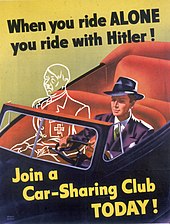
Carpooling first became prominent in the United States as a rationing tactic during Globe State of war 2. Ridesharing began during Earth War II through "motorcar clubs" or "car-sharing clubs".[ten] The U.s.a. Function of Noncombatant Defence force asked neighborhood councils to encourage four workers to share a ride in one automobile to conserve rubber for the war effort. It as well created a ride sharing program chosen the Auto Sharing Guild Exchange and Self-Dispatching System. Carpooling returned in the mid-1970s due to the 1973 oil crisis and the 1979 energy crisis. At that time the starting time employee vanpools were organized at Chrysler and 3M.[11]
Carpooling declined precipitously between the 1970s and the 2000s, peaking in the US in 1970 with a commute manner share of xx.4%. Past 2011 information technology was down to 9.7%. In large function this has been attributed to the dramatic fall in gas prices (45%) during the 1980s. In the 1990s information technology was popular amidst college students, where campuses have express parking space. Together with Prof. James Davidson from Harvard, Dace Campbell, Ivan Lin and Habib Rached from Washington, and others, began to investigate the feasibility of farther development although the comprehensive technologies were not commercially available yet at the time. Their work is considered by many to be a precursor of carpooling & ridesharing systems engineering science used past Garrett Campsite, Travis Kalanick, Oscar Salazar and Conrad Whelan at Uber.[12] [xiii] [x] [14]
The character of carpool travel has been shifting from "Dagwood Bumstead" variety, in which each rider is picked up in sequence, to a "park and ride" variety, where all the travelers meet at a mutual location. Recently, yet, the Internet has facilitated growth for carpooling and the commute share mode has grown to 10.7% in 2005. In 2007 with the advent of smart phones and GPS, which became commercially available, John Zimmer and Logan Green, from Cornell University and University of California, Santa Barbara respectively, rediscovered and created carpooling organisation called Zimride, a precursor to Lyft. The popularity of the Internet and smart phones has greatly helped carpooling to expand, enabling people to offer and notice rides thank you to like shooting fish in a barrel-to-use and reliable online send marketplaces. These websites are commonly used for one-off long-altitude journeys with high fuel costs.[3] [x] [15]
In Europe, long-altitude car-pooling has become increasingly popular over the past years, thanks to BlaBlaCar. According to its website, as of 2020[update], Blablacar counted more than 80 million[16] users, across Europe and beyond.
Equally of March 2020[update], Uber and Lyft have suspended carpooling services in the U.S. and Canada in efforts to command the COVID-19 pandemic via social distancing.[17] [xviii]
Other forms [edit]
Carpooling exists in other forms:
- Slugging is a form of ad hoc, breezy carpooling between strangers. No money changes hands, only a mutual benefit yet exists betwixt the driver and passenger(s) making the do worthwhile.
- Flexible carpooling expands the idea of ad hoc carpooling by designating formal locations for travelers to bring together carpools.
- Ridesharing companies allow people to adjust ad hoc rides on very short observe, through the use of smartphone applications or the internet. Passengers are simply picked upwardly at their electric current location.
Challenges [edit]

The share of Usa workers commuting by carpool has declined from 20.4% in 1970 to simply 9.7% in 2011.
- Flexibility - Carpooling tin can struggle to exist flexible enough to accommodate in road stops or changes to working times/patterns. 1 survey identified this as the most common reason for not carpooling.[5] To counter this some schemes offer 'sweeper services' with subsequently running options, or a 'guaranteed ride home' arrangement with a local taxi company.
- Reliability - If a carpooling network lacks a "critical mass" of participants, information technology may exist difficult to find a friction match for certain trips. The parties may not necessarily follow through on the agreed-upon ride. Several internet carpooling marketplaces are addressing this business organization by implementing online paid passenger reservation, billed even if passengers do not plow up.
- Riding with strangers - Concerns over security have been an obstacle to sharing a vehicle with strangers, though in reality the take a chance of crime is minor.[19] Ane remedy used by internet carpooling schemes is reputation systems that flag problematic users and allow responsible users to build up trust majuscule, such systems greatly increase the value of the website for the user community.
- Overall efficacy - Though carpooling is officially sanctioned by near governments, including construction of lanes specifically allocated for car-pooling, some doubts remain as to the overall efficacy of carpool lanes. Equally an instance, many car-puddle lanes, or lanes restricted to car-pools during peak traffic hours, are seldom occupied by automobile-pools in the traditional sense.[20] Instead, these lanes are frequently empty,[20] leading to an overall net increase in fuel consumption every bit expressway capacity is possibly contracted, forcing the solo-occupied cars to travel slower, leading to reduced fuel efficiency[ commendation needed ].
- In 2012, the Queensland government announced it would end carpool lanes (known equally Transit Lanes) claiming they were creating congestion and delays. The move was supported past the RACQ motoring group.[21]
- No carpooling service provides the ability for drivers to declare the time range during which they provide services in accelerate. Although the bulk of carpooling services use a mobile awarding, this is non the example for interurban carpooling services (i.eastward., Ride joy and Autostrade carpooling). In improver, no carpooling was constitute to guarantee a minimum delay for drivers or a unmarried dropoff/pickup point. Some carpooling platforms (i.e., TwoGo and BlaBlaLines operated by BlablaCar) use an intelligent engineering science to analyze rides from all users to find the all-time fit for each user. This intelligent technlogy even factors in real-time traffic data to calculate precise routes and arrival times. [22]
In popular civilization [edit]
- In the 1970s, the U.s.a. Department of Transportation released a humorous, animated public service announcement to promote carpooling entitled "Kalaka." In the commercial, an interviewer is shown talking to Noah, "the original share-the-ride-with-a-friend human being." Noah explains that carpooling is an economical fashion to get where you're going, but dorsum in his time it was known equally "kalaka."[23] [24]
- Cabbing All the Way is a book written by author Jatin Kuberkar that narrates a success story of a carpool with twelve people on board. Based in the city of Hyderabad, India, the book is a existent life narration and highlights the potential benefits of having a carpool.[25]
- The 2017 smartphone game Crazy Taxi Tycoon (formerly titled Crazy Taxi Gazillionaire) antagonizes ride-sharing as a threat to taxi business concern, as information technology becomes a powerful megacorporation that rips off those whom it serves. The role player is tasked in hiring taxi drivers to establish a taxi service that offers a more legitimate, friendly and reliable transport experience.[26]
Come across as well [edit]
- Flight sharing
- Fuel tax
- Hitchhiking
- Public transportation
- Ridesharing visitor
- Rota (schedule)
- Shared transport
- Slugging
- Sustainable transportation
- Traditional car sharing and peer-to-peer carsharing
- Vanpool
- When Yous Ride Lonely You Ride with bin Laden
References [edit]
- ^ "U.S. Section of Transportation, Federal Highway Administration, 2009 National Household Travel Survey". U.S. Federal Highway Administration. Archived from the original on 23 Oct 2013. Retrieved 2014-01-29 .
- ^ Park, Haeyoun; Gebeloff, Robert (28 January 2011). "Auto-Pooling Declines as Driving Becomes Cheaper". The New York Times.
- ^ a b c Stephen DeLoach and Thomas Tiemann. Not driving lone: Commuting in the 20-first century. Elon Academy Department of Economics. 2010.
- ^ Nathan Belz and Brian Lee. Composition of Vehicle Occupancy for Journey-To-Work Trips: Prove of Ridesharing from the 2009 National Household Travel Survey Vermont Improver Sample. Transportation Enquiry Board 2012.
- ^ a b Jianling Li, Patrick Embry, Stephen P. Mattingly, Kaveh Farokhi Sadabadi, Isaradatta Rasmidatta, and Mark Westward. Burris. Who Chooses to Carpool and Why? Test of Texas Carpoolers. Transportation Research Record, 2007.
- ^ "GreenXC Website". GreenXC About. Archived from the original on 4 June 2011. Retrieved 26 June 2011.
- ^ "Source: The state of European Car Sharing, Car Sharing development strategy of greater London, p. 96-98: white-newspaper past Momo (European enquiry projection on sustainable mobility patterns), June 2010" (PDF) . Retrieved 29 January 2014.
- ^ "Demokrata.hu". 19 March 2012. Archived from the original on thirty May 2012. Retrieved 2012-04-06 .
- ^ "How prices are calculated". Poparide Help . Retrieved 4 April 2021.
- ^ a b c Chan, Nelson D. & Susan A. Shaheen (2012) Ridesharing in Due north America: Past, Present, and Future. Archived 4 February 2014 at the Wayback Machine Ship Reviews 32 (1): 93–112.
- ^ Marc Oliphant & Andrew Amey. Dynamic Ridesharing: Carpooling Meets the Information Age. 2010.
- ^ Erik Ferguson. The ascension and fall of the American carpool: 1970–1990. Transportation 24.iv. (1997)
- ^ 5 Jenius Republic of indonesia Yang Sukses Di Tingkat Dunia (5 Successful Indonesian Geniuses on a World Level) 23 July 2015. Elizabeth Chen.
- ^ Shontell, Alyson (eleven January 2014). "All Hail the Uber Man! How Sharp-Elbowed Salesman Travis Kalanick Became Silicon Valley'southward Newest Star". Business Insider . Retrieved 1 January 2020.
- ^ Farr, Christina (23 May 2013). "Lyft team gets $60M more; at present it must prove ride-sharing can become global". VentureBeat . Retrieved 1 January 2020.
- ^ "Nearly Us". BlaBlaCar . Retrieved one Jan 2020.
- ^ "Uber and Lyft suspend carpooling in response to coronavirus pandemic". 17 March 2020.
- ^ Bond, Shannon (17 March 2020). "Uber, Lyft Halt Shared Carpool Service in U.South. And Canada". NPR.
- ^ Dallmeyer, Yard. Due east. (4 February 1976). "Hitchhiking: a Viable Improver to a Multimodal Transportation Arrangement: Prepared for National Science Foundation, 1975". Trid.trb.org. Retrieved 29 January 2014.
- ^ a b Templeton, Brad. "Carpool Cheats May Be Helping Traffic; How HOV Lanes Can Fail". Forbes . Retrieved 4 Apr 2021.
- ^ "Transit lanes video|RACQ backs program to scrap T2 lanes, Brisbane". 22 December 2013. Archived from the original on 22 December 2013. Retrieved 3 Apr 2018.
- ^ Mitropoulos, L.; Kortsari, A.; Ayfantopoulou, 1000. (1 September 2021). "Factors Affecting Drivers to Participate in a Carpooling to Public Transport Service". Sustainability.
- ^ "U.Southward. DEPARTMENT OF TRANSPORTATION: KALAKA". paleycenter.org. Retrieved 31 May 2020.
- ^ "Kalaka - aye the word for car pooling". YouTube.com. Archived from the original on 21 Dec 2021. Retrieved 31 May 2020.
- ^ Cabbing All the Way
- ^ Padla, Rei (ii June 2017). "SEGA launches new 'Crazy Taxi Gazillionaire' strategy game". Android Customs . Retrieved 31 Oct 2018.
External links [edit]
 | Wikimedia Commons has media related to Carpooling. |
- Carpooling at Curlie
Source: https://en.wikipedia.org/wiki/Carpool
0 Response to "Cardpool Sorry"
Post a Comment